Showing posts with label Christian Passover. Show all posts

Sunday, December 17, 2017

The Last Supper and the Crucifixion are inextricably united.


Anti-Catholic asks:

The Last Supper is not the Sacrifice on the Cross

WHEN did Jesus cry out to Abba to remove this cup from Him : before the Supper of before the Cross?

WHEN was the Sin of believers paid for: at the Supper or on the Cross?

WHEN was propitiation made: at the Supper or on the Cross?

WHEN was the Blood of Christ shed for our forgiveness ; at the Supper or on the Cross?

WHEN was the wrath of God appeased : at the Supper or on the Cross?

WHEN was he pierced for our transgressions, When was he crushed for our iniquities; at the Supper or on the Cross?

WHEN did the Lord lay on him the iniquity of us all; at the Supper or on the Cross?

WHEN was the Lord’s will to crush him and cause him to suffer, and though the Lord makes his life an offering for sin; at the Supper or on the Cross?

WHEN did God make Him who had no sin to be sin for us, so that in Him we might become the righteousness of God;at the Supper or on the Cross?

At what "event " did these thing happen?
Your questions are loaded with misunderstanding. The Last Supper and the Crucifixion are inextricably united.

You see, the Last Supper is the first Mass. And the Mass is our Passover. In order to understand the New Testament Mass, you must understand the Old Testament Passover.

1. In the Old Testament, 

a. The Passover Lamb was killed and 
b. The Passover Lamb was eaten.

Those are not two sacrifices, but one. The Passover Lamb was killed in order that it might be eaten.

2. The same in the New Testament.

a. Jesus Christ is the Lamb of God. 
John 1:29
The next day John seeth Jesus coming unto him, and saith, Behold the Lamb of God, which taketh away the sin of the world.

b. Jesus Christ is also our Passover, sacrificed for us.
1 Corinthians 5:7
Purge out therefore the old leaven, that ye may be a new lump, as ye are unleavened. For even Christ our passover is sacrificed for us:

c. He is sacrificed for us in order that He may be eaten:
John 6:57
King James Version (KJV)
57 As the living Father hath sent me, and I live by the Father: so he that eateth me, even he shall live by me.

d. Therefore, Christ released the grace of God from the Cross. But unless you eat of the flesh of the Son of God, you do not apply those graces to your life. And you will die in your sins:
53 Then Jesus said unto them, Verily, verily, I say unto you, Except ye eat the flesh of the Son of man, and drink his blood, ye have no life in you.

e. And finally, the Crucifixion is the Sacrifice of the Mass which we participate in when we eat the Body and Blood of our Lord in the Holy Eucharist.

Friday, November 13, 2015

Why it's called the Mass, (aka Its not from Ite misa est).

Masa/dough

A couple of weeks ago, on Catholic365, I asked the question, "Why is it called "the Mass"?  In that article, I challenged the consensus that the name of the Catholic Liturgy comes from the dismissal.  And I suggested the Mass derives from the Latin root "masa" which is an ancient and universal word signifying bread.

Massah/test

I followed that up with another article, The Mass, St. John chapter 6 and the test of faith.  In this article, I suggested that it is more likely that the name of the Mass derives from the Hebrew word massah or test. Another ancient word which can be traced to Moses' time, when the Israelites tested God in the desert.  That ties back to the idea that the Doctrine of the Eucharist is so hard for many to believe, that it is a test (massah) of faith as witnessed in John 6 when many walked away from Christ based upon that Teaching.

Masa goes back to Moses

What I didn't know at the time, is that the Latin root, "masa" derives from the Greek word "mazza" which signifies "wheat cakes" and that Greek word derives from the Hebrew "matstsah" which means, unleavened bread.  And that ties the word "masa" directly to the Passover.  Again, all the way back to Moses' time.

Not a Teaching from the Early Church

But, someone said that I am opposing the Church.  They claimed this was a Teaching from the early Church.

That is not the case, the oldest document I could find that ties the Mass to the dismissal, is from the Catholic Encyclopedia, Liturgy of the Mass.  This article makes the claim that "mass" derives from the Latin "misa" in the dismissal of the Latin Mass.  But I think I've detected several errors in the logic used to arrive at that conclusion.

Let's go through it together.  I'll skip to the pertinent parts.  But you can examine my findings in the link above.

Under the Category, "Name and Definition"

The first paragraph is an introduction to the theory that the word "misa" was not in extensive use in the first and second centuries.  He says:
....the Holy Eucharist was celebrated as Christ had instituted it at the Last Supper, according to His command, in memory of Him. But it was not till long afterwards that the late Latin name Missa, used at first in a vaguer sense, became the technical and almost exclusive name for this service.
I can't disagree with that.  The only thing to say, perhaps, is that there is really no way to know, since we don't have very much from that early date.

The 2nd paragraph begins in the same vein.  Relating how, in the first period (the first 300 years), even in Rome, the Greek language was the language of Christianity.

Nothing there with which to disagree.  One thing to note, however, is that during that period, none of the names for the Mass signify a dismissal or departure.  Many of them do make a reference to the Eucharist, such as, eucharistia and koinonia.

The 3rd paragraph begins the transition, in the West, from the Greek to the Latin language and the appearance of the word, misa.  Let's look at what he says:

All these were destined to be supplanted in the West by the classical name Missa. The first certain use of it is by St. Ambrose (d. 397). He writes to his sister Marcellina describing the troubles of the Arians in the years 385 and 386, when the soldiers were sent to break up the service in his church: "The next day (it was a Sunday) after the lessons and the tract, having dismissed the catechumens, I explained the creed [symbolum tradebam] to some of the competents [people about to be baptized] in the baptistry of the basilica. There I was told suddenly that they had sent soldiers to the Portiana basilica. . . . But I remained at my place and began to say Mass [missam facere coepi]. While I offer [dum ofero], I hear that a certain Castulus has been seized by the people" (Ep., I, xx, 4-5). It will be noticed that missa here means the Eucharistic Service proper, the Liturgy of the Faithful only, and does not include that of the Catechumens. Ambrose uses the word as one in common use and well known.
There are some very interesting things said there.

1st.  He (St. Ambrose) dismissed the Catechumens.

How did he dismiss them?  Did he use the word, "misa" in the sense of dismissal when he did so?

2nd.  There I was told suddenly that they had sent soldiers

How did they send them?  Did they use the word, "misa" in the sense of sending when they did so?

Apparently not, I'm sure he would have said so since the entire point of this article is how "mass" is derived from a form of "dismissal".

But there's more.

3rd.  But I remained at my place and began to say Mass [missam facere coepi]. 

St. Ambrose uses the word "missa" for the Mass in such a matter of fact manner that the author is forced to admit,
It will be noticed that missa here means the Eucharistic Service proper, the Liturgy of the Faithful only, and does not include that of the Catechumens. Ambrose uses the word as one in common use and well known.
In fact, St. Ambrose is using the term in the same way that it is used today.  The author makes noise about it being a reference to the Liturgy of the Faithful.  But, so what?  It remains a reference to the Eucharist as he also admits.

Still on the 3rd paragraph, the author continues:
There is another, still earlier, but very doubtfully authentic instance of the word in a letter of Pope Pius I (from c. 142 to c. 157): "Euprepia has handed over possession of her house to the poor, where . . . we make Masses with our poor" (cum pauperibus nostris . . . missas agimus" — Pii I, Ep. I, in Galland, "Bibl. vet. patrum", Venice, 1765, I, 672). The authenticity of the letter, however, is very doubtful. If Missa really occurred in the second century in the sense it now has, it would be surprising that it never occurs in the third. We may consider St. Ambrose as the earliest certain authority for it.
Personally, if that is the only reason he doubts the authenticity of this letter, then he has no grounds at all except his own presupposition that it could not be true.

Intermission (pun not intended)

To me, that puts the last nail on the coffin for the idea that the "mass" comes from the dismissal.   However, something to note in the remainder of the article.  Although, the author wants us to see a progressive use of the word "misa" as dismissal and then somehow to jump to the conclusion that "misa" therefore comes from dismissal, we need only remember that the word "misa" as the Eucharist already exists.  There is no need to conclude that "misa" comes from "dismissal".  In fact, it is very likely in my mind, that the word "misa" becomes a conjugal form of "mittere" due to the its continued association with the dismissal.

What?  Isn't that what the author says?

No.  I'm saying that dismiss comes from misa.  Not that misa comes from dismiss.  I'm saying that the root word for dismissal comes into existence due to its continued assocation with the dismissal at the end of the Mass of the Catechumens.

In other words, Its time for the Mass takes on the meaning, its time to depart (i.e. misa).  Anyway, let's get back to the article:

4th paragraph, he says,

From the fourth century the term becomes more and more common. For a time it occurs nearly always in the sense of dismissal. St. Augustine (d. 430) says: "After the sermon the dismissal of the catechumens takes place" (post sermonem fit missa catechumenorum — Serm., xlix, 8, in P.L., XXXVIII, 324). 
I'm not a Latin expert, but I read that as saying, "After the sermon, ends (fin) the mass of the Catechumens".  And, of course, the Catechumens are dismissed.

But, even if I'm wrong, we know that the word "missa" for Mass, already exists.  Therefore, this would be an example of the word now becoming associated with the dismissal.  Not an example of the dismissal being the source of the name for the Mass.

4th paragraph continued

The Synod of Lérida in Spain (524) declares that people guilty of incest may be admitted to church "usque ad missam catechumenorum", that is, till the catechumens are dismissed (Can., iv, Hefele-Leclercq, "Hist. des Conciles", II, 1064).
I put that phrase in the Google Translate tool and here is what I got, "as far as the mass of catechumens".  Try it yourself.

He says that phrase is used very frequently.  And I say, the phrase doesn't mean what he thinks it means.

Anyway, in the 4th paragraph, he continues with examples of that phrase as though they prove his point, when in fact, they prove simply that the Mass was always called the Mass.  Then he says that "misa" suddenly gets the connotation as the entire Liturgy.  Which, I think is disproved by his very first comments on the subject in paragraph 3.

But in the 5th paragraph, he says,
The origin and first meaning of the word, once much discussed, is not really doubtful. We may dismiss at once such fanciful explanations as that missa is the Hebrew missah ("oblation" — so Reuchlin and Luther), or the Greek myesis ("initiation"), or the German Mess ("assembly", "market").  
I was quite surprised when I read this.  I didn't realize that he knew anything about these arguments.  But, it seems really arrogant of him to say that these can merely be dismissed because he says so.  In my opinion it is much more plausible for these to be the source of the name for the Mass, than the convoluted and faulty reason he has proposed.

He goes on and says:
Nor is it the participle feminine of mittere, with a noun understood ("oblatio missa ad Deum", "congregatio missa", i.e., dimissa — so Diez, "Etymol. Wörterbuch der roman. Sprachen", 212, and others).
This is what most people seem to believe today.  I guess they didn't bother to read the whole article.

Then he says:
It is a substantive of a late form for missio. There are many parallels in medieval Latin, collecta, ingressa, confessa, accessa, ascensa — all for forms in -io. It does not mean an offering (mittere, in the sense of handing over to God), but the dismissal of the people, as in the versicle: "Ite missa est" (Go, the dismissal is made). It may seem strange that this unessential detail should have given its name to the whole service.
I guess he didn't bother to read the etymology for the word, "missio".  It turns out, that the word "missio" comes from the Catholic Church.  It is attributed to the Jesuits.

mission (n.) Look up mission at Dictionary.com
1590s, "a sending abroad," originally of Jesuits, from Latin missionem (nominative missio) "act of sending, a despatching; a release, a setting at liberty; discharge from service, dismissal," noun of action from past participle stem of mittere "to send," oldest form probably *smittere, of unknown origin. 

Essentially, what the Catholic Encycopledia has proven, is that the word "dismiss" comes from the name for the Liturgy of the Eucharist, the Mass.

Let me know what you think.


Tuesday, September 16, 2014

Christ is our Passover, as Scripture clearly tells us.


Lutero:

With all due respect, you are showing me nothing except your desperate attempt to fit a square peg into a round hole.
Revelation 5:5 tells us, the Lamb, "the Lion of the tribe of Judah, has triumphed". That is why He alone is worthy to open the scroll. The Lord Jesus died for our sins and God has accepted Calvary as full payment for our redemption. You should also.
Do you not recall what scripture says, that before He was crucified, Jesus, when praying to His Father, said “I have brought you glory on earth bycompleting the work you gave me to do”. And at the cross, our dear savior, before giving up His Spirit, said “It is finished”.
What's finished, redemption? Then you are left out.

Yet here you are, willfully editing the infallible word of God, equating the bloodless sacrifice of your Church’s pagan ritual to the worship given to God in heaven. All because you value the teachings of the Roman Catholic Church over the infallible word of God. Repent before it's too late.
On the contrary, it is you. Christ is our Passover, as Scripture clearly tells us. And Scripture shows us that He continually offers Himself to the Father in our behalf. All you have to do is read the Scriptures with spiritual discernment:


1 Corinthians 2:14
But the natural man receiveth not the things of the Spirit of God: for they are foolishness unto him: neither can he know them, because they are spiritually discerned.
Why would the Lamb be standing in heaven as though slain unless Christ is offering Himself to the Father?

Revelation 5:6

King James Version (KJV)

6 And I beheld, and, lo, in the midst of the throne and of the four beasts, and in the midst of the elders, stood a Lamb as it had been slain, having seven horns and seven eyes, which are the seven Spirits of God sent forth into all the earth.

Sincerely,

De Maria

Friday, July 11, 2014

Where do we find the passover becomes the mass?


Lutero:
Where do we find the passover becomes the mass?
Here.

Matthew 26:16-18

King James Version (KJV)

16 And from that time he sought opportunity to betray him.
17 Now the first day of the feast of unleavened bread the disciples came to Jesus, saying unto him, Where wilt thou that we prepare for thee to eat the passover?
18 And he said, Go into the city to such a man, and say unto him, The Master saith, My time is at hand; I will keep the passover at thy house with my disciples.

Note that Jesus prepares the disciples for a Passover. But this is what He says during that Passover:
26 And as they were eating, Jesus took bread, and blessed it, and brake it, and gave it to the disciples, and said, Take, eat; this is my body.
27 And he took the cup, and gave thanks, and gave it to them, saying, Drink ye all of it;
28 For this is my blood of the new testament, which is shed for many for the remission of sins.

Jesus prepared the disciples for a Passover. But during that Passover, celebrated the Mass. St. Paul obviously understands this:
1 Corinthians 5:7

King James Version (KJV)

7 Purge out therefore the old leaven, that ye may be a new lump, as ye are unleavened. For even Christ our passover is sacrificed for us:


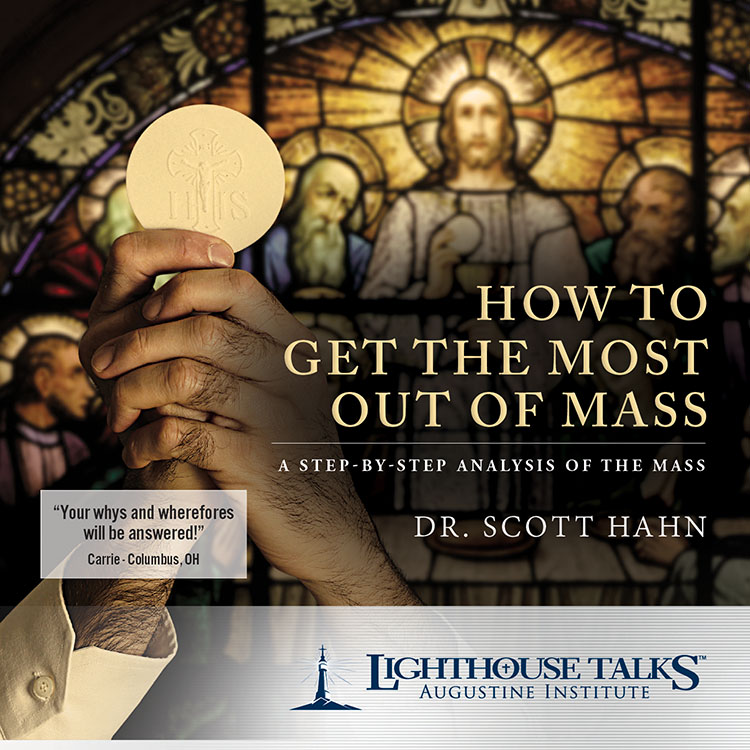
How to Get the Most Out of Mass
So what does it mean that YOU are now UNLEAVENED?.

St. Paul is using "leavening" in a metaphorical sense. To understand the metaphor, you must go to the Old Testament. Before the Passover, the Jews were supposed to clean house throw out all leavening:
Exodus 12:15

King James Version (KJV)

15 Seven days shall ye eat unleavened bread; even the first day ye shall put away leaven out of your houses: for whosoever eateth leavened bread from the first day until the seventh day, that soul shall be cut off from Israel.

When St. Paul says, 
Purge out therefore the old leaven, he is referring to sin. We become one bread, one body with Christ. And before we eat of the Eucharist, our Passover, we must examine ourselves:

1 Corinthians 11:28-30

King James Version (KJV)

28 But let a man examine himself, and so let him eat of that bread, and drink of that cup.
29 For he that eateth and drinketh unworthily, eateth and drinketh damnation to himself, not discerning the Lord's body.
30 For this cause many are weak and sickly among you, and many sleep.

When we unite ourselves to Christ in the Holy Eucharist, we must be a pure lump, that ye may be a new lump, as ye are unleavened, without sin.


Where does scripture say if they did not eat the lamb they would die?
Hebrews 10:

King James Version (KJV)

25 Not forsaking the assembling of ourselves together, as the manner of some is; but exhorting one another: and so much the more, as ye see the day approaching.
26 For if we sin wilfully after that we have received the knowledge of the truth, there remaineth no more sacrifice for sins,
27 But a certain fearful looking for of judgment and fiery indignation, which shall devour the adversaries.
28He that despised Moses' law died without mercy under two or three witnesses:


I know there was something they had to do to preserve their lives.. but it was not to eat the lamb ... infact they were told to burn the lamb they did not eat.. so what was the sign they were to use to save their lives?
To mark the doorposts with the blood.


First you have to show where God commanded the "mass "as a new passover ...
On the contrary, you have to show where Scripture says that the Mass is not the Passover. I have shown you where our Traditions and doctrines are in line with Scripture. You have shown nothing from Scripture. Absolutely nothing.


What you do is isogesus..
What you offer is mere opinion with no support.


you look up scripture or read it to support what you want it to say . The passover was once a year as a memorial commandment ..it pointed to Christ
Exactly! It pointed to Christ. Because Christ is the True Passover. And long ago, it was prophecied that Christ would become the Daily Offering:

Malachi 1:11

King James Version (KJV)

11 For from the rising of the sun even unto the going down of the same my name shall be great among the Gentiles; and in every place incense shall be offered unto my name, and a pure offering: for my name shall be great among the heathen, saith the Lord of hosts.


It is indeed a fearful thing to fall into the hands of the living God..because there was only ONE sacrifice for sin.. and that was on Calvary.. there are no more daily sacrifices
It is that same sacrifice of Calvary which we offer and consume. 


Maria.. what did the cross accomplish ? How is is sufficient to you?
Jesus accomplished the salvation of all who OBEY Him on the Cross. 

Hebrews 5:

King James Version (KJV)

8 Though he were a Son, yet learned he obedience by the things which he suffered;


9 And being made perfect, he became the author of eternal salvation unto all them that obey him;

In so doing, He established an example that we should follow in His steps:

1 Peter 2:21

King James Version (KJV)

21 For even hereunto were ye called: because Christ also suffered for us, leaving us an example, that ye should follow his steps:

Sincerely,

De Maria

Friday, August 10, 2012

The Christian Passover


I like to mention that the Mass is the Christian Passover:
1 Corinthians 5:7
King James Version (KJV)
7Purge out therefore the old leaven, that ye may be a new lump, as ye are unleavened. For even Christ our passover is sacrificed for us:
St. Paul obviously ties in the Sacrifice of Christ, the Lamb of God, to the Jewish Passover. A Sacrifice in which the Jewish people participated by eating the Passover Lamb.
That is why it was necessary for Christ, the Lamb of God:
John 1:29
King James Version (KJV)
29The next day John seeth Jesus coming unto him, and saith, Behold the Lamb of God, which taketh away the sin of the world.
to give us the bread which is His Flesh:
John 6:51
King James Version (KJV)
51I am the living bread which came down from heaven: if any man eat of this bread, he shall live for ever: and the bread that I will give is my flesh, which I will give for the life of the world.
So that eating of it, we might obtain eternal life:
1 Corinthians 11:25-29
King James Version (KJV)
25After the same manner also he took the cup, when he had supped, saying, this cup is the new testament in my blood: this do ye, as oft as ye drink it, in remembrance of me.
26For as often as ye eat this bread, and drink this cup, ye do shew the Lord’s death till he come.
27Wherefore whosoever shall eat this bread, and drink this cup of the Lord, unworthily, shall be guilty of the body and blood of the Lord.
28But let a man examine himself, and so let him eat of that bread, and drink of that cup.
29For he that eateth and drinketh unworthily, eateth and drinketh damnation to himself, not discerning the Lord’s body.
John 6:54
King James Version (KJV)
54Whoso eateth my flesh, and drinketh my blood, hath eternal life; and I will raise him up at the last day.
Sincerely,
De Maria