
Washed, Sanctified and Justified in the Sacraments of the Catholic Church.
Showing posts with label Sacraments. Show all posts
Showing posts with label Sacraments. Show all posts
Saturday, October 9, 2021


Friday, October 1, 2021

Saturday, September 25, 2021
Can a 2 month old believe? -2
DM- Answer the questions which I asked. Who's faith did Jesus take into account when He brought the maiden back to life? The maid had died, does a dead body have faith? Therefore, Jesus revived her because of the faith of her parents.
Luke 8:50-55How about the Canaanite woman's daughter? Who's faith did Jesus take into account, the daughter's or the mother's? Here's what Jesus said:
Matt 15:Then Jesus answered and said unto her, O woman, great is thy faith: be it unto thee even as thou wilt. And her daughter was made whole from that very hour.
Notice that He didn't say, "your daughter's faith is great." But He cured the daughter because of the faith of her mother. In the same way, Jesus brings our children into spiritual life, based upon the faith of the parents.
Friday, September 17, 2021
Friday, June 19, 2020
Only God justifies
SM says:
The Catholic Church teaches a law tinged gospel which is not pure.
Let's compare your words to Scripture:
Romans 2:13 (For not the hearers of the law are just before God, but the doers of the law shall be justified.
Romans 8:7 Because the carnal mind is enmity against God: for it is not subject to the law of God, neither indeed can be.
In reality (although is says it is not), the Catholic Church is semi-Pelagian.‘A lot of God…and a little bit of you.’
Wrong. Pelagian means that you believe that you can save yourself without God. That is parallel with the Protestant idea that you can save yourself by your faith alone.
Semi-Pelagian says that people have the capacity to turn to God without God's initiative. Without the prevenient grace of God.
The Catholic Church teaches that only God justifies. And we only turn to God when God gives us the prevenient grace of faith to believe in Him and to believe in His goodness and to diligently seek Him. And that this requires us to obey His call in order to be saved:
Romans 6:16
Know ye not, that to whom ye yield yourselves servants to obey, his servants ye are to whom ye obey; whether of sin unto death, or of obedience unto righteousness?
Hebrews 5:9
And being made perfect, he became the author of eternal salvation unto all them that obey him;
And if that’s the case, then why would Jesus even bother with the Cross?
In order to pour out His grace upon us in the Sacraments.
He could just as easily line us all up and judge us on how well we are doing.
That happens to all who submit to the Sacraments. The Sacraments are prejudgement events. When we approach the Sacraments, God looks in our souls as He did at Abraham and says, "He believes, therefore he is righteous".
But God only does this for those who keep His Law:
Romans 2:13 (For not the hearers of the law are just before God, but the doers of the law shall be justified.
Those who refuse to keep God's law, blaspheme if they approach the fountains of grace and are condemned:
Mark 16:16 He that believeth and is baptized shall be saved; but he that believeth not shall be damned.
But EVERYONE will stand before the judgment seat of Christ on the last day. EVERYONE:
Romans 14:10
But why dost thou judge thy brother? or why dost thou set at nought thy brother? for we shall all stand before the judgment seat of Christ.
2 Corinthians 5:10
For we must all appear before the judgment seat of Christ; that every one may receive the things done in his body, according to that he hath done, whether it be good or bad.
This from a lifelong Catholic who finally heard the gospel preached in it’s purity. Without the add-on’s on self, or clergy having to be attached to it.
It is the Protestants who have added to and taken from the Word of God and changed the Gospel of Jesus Christ in their own image.
Sincerely,
De Maria
Friday, January 31, 2020
Saturday, September 15, 2018
Every one of the Sacraments is a bestowal and effusion of divine grace
Hi ya'll,
I’m a latecomer to the discussion, but I saw the term, “Catholic point of view” bandied back and forth and the only point of view I saw was justification by faith and works ascribed to the Catholic paradigm..
Whereas, Trent says:
Trent VI
CHAPTER VIII
HOW THE GRATUITOUS JUSTIFICATION OF THE SINNER BY FAITH IS TO BE UNDERSTOODBut when the Apostle says that man is justified by faith and freely,[44] these words are to be understood in that sense in which the uninterrupted unanimity of the Catholic Church has held and expressed them, namely, that we are therefore said to be justified by faith, because faith is the beginning of human salvation, the foundation and root of all justification, without which it is impossible to please God[45] and to come to the fellowship of His sons; and we are therefore said to be justified gratuitously, because none of those things that precede justification, whether faith or works, merit the grace of justification.For, if by grace, it is not now by works, otherwise, as the Apostle says, grace is no more grace.[46]
we are therefore said to be justified gratuitously, because none of those things that precede justification, whether faith or works, merit the grace of justification.
Therefore, the Catholic paradigm is twofold.
We inherited the Justification by faith and works from the Jews. Wherein, those who keep the Commandments are forensically justified by God at the Judgment Seat. We must all stand before that seat where we will be judged according to our works.
But Jesus Christ has received and established a New Dispensation, wherein we are now justified by our faith apart from any works, in the Sacraments of the Catholic Church. Especially and primarily in the Sacrament of Baptism.
However, everyone of the Sacraments is a bestowal and effusion of divine grace which washes away our sins and unites us to God. And we present ourselves to receive the gift of the Holy Spirit to the extent of our faith as long as we put no obstacles in the way of God’s outpouring of grace in our soul.
Wednesday, March 8, 2017
Baptism justifies and saves
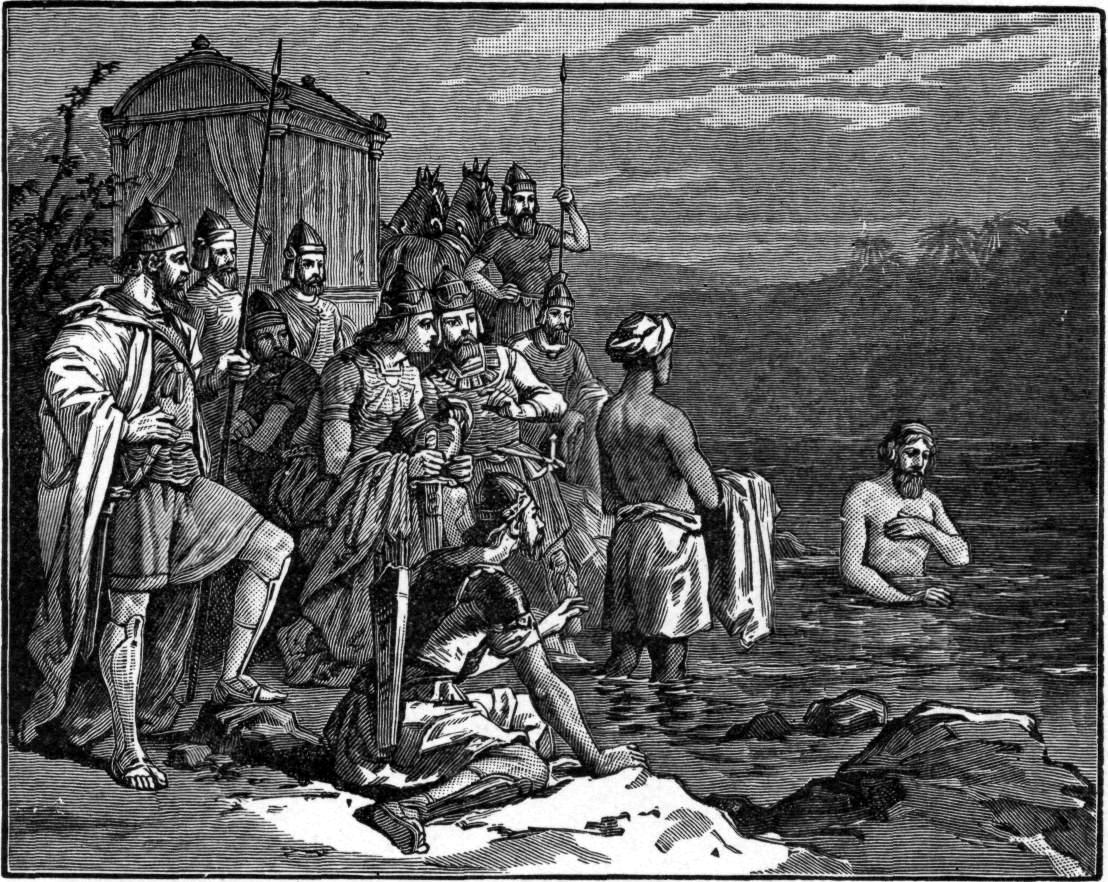 |
| Naaman washed, 7 times, in the Jordan |
Baptism does not justify.
Christ justifies through Baptism. Do you, like Naaman, deny that God can work through the water?
2 Kings 5:10 And Elisha sent a messenger unto him, saying, Go and wash in Jordan seven times, and thy flesh shall come again to thee, and thou shalt be clean. 11 But Naaman was wroth, and went away, and said, Behold, I thought, He will surely come out to me, and stand, and call on the name of the Lord his God, and strike his hand over the place, and recover the leper. 12 Are not Abana and Pharpar, rivers of Damascus, better than all the waters of Israel? may I not wash in them, and be clean? So he turned and went away in a rage.
God can even heals through the mud:
John 9:11 He answered and said, A man that is called Jesus made clay, and anointed mine eyes, and said unto me, Go to the pool of Siloam, and wash: and I went and washed, and I received sight.
This is all plainly taught in Scripture.
Through Baptism.
2 Kings 5:10 And Elisha sent a messenger unto him, saying, Go and wash in Jordan seven times, and thy flesh shall come again to thee, and thou shalt be clean. 11 But Naaman was wroth, and went away, and said, Behold, I thought, He will surely come out to me, and stand, and call on the name of the Lord his God, and strike his hand over the place, and recover the leper. 12 Are not Abana and Pharpar, rivers of Damascus, better than all the waters of Israel? may I not wash in them, and be clean? So he turned and went away in a rage.
God can even heals through the mud:
John 9:11 He answered and said, A man that is called Jesus made clay, and anointed mine eyes, and said unto me, Go to the pool of Siloam, and wash: and I went and washed, and I received sight.
This is all plainly taught in Scripture.
Christ justifies
Through Baptism.
Baptism is a signIt is an effective sign which accomplishes what it signifies by the Power of God.
How silly to believe that someone is committing blasphemy by knowing that it is the power of Christ, not water that justifies.How silly to make that claim. We know that it is Christ working through the Sacrament. That is the Catholic Teaching:
1127 Celebrated worthily in faith, the sacraments confer the grace that they signify. They are efficacious because in them Christ himself is at work: it is he who baptizes, he who acts in his sacraments in order to communicate the grace that each sacrament signifies. The Father always hears the prayer of his Son's Church which, in the epiclesis of each sacrament, expresses her faith in the power of the Spirit. As fire transforms into itself everything it touches, so the Holy Spirit transforms into the divine life whatever is subjected to his power.
But Christ has connected justification and the water by the Word. Therefore, the Sacrament is efficacious:
Ephesians 5:26That he might sanctify and cleanse it with the washing of water by the word,
Certainly we never want to take anything away from baptism,But you have already in declaring your unbelief that God can use the water to wash away our sins:
Mark 16:16 He that believeth and is baptized shall be saved; but he that believeth not shall be damned.
but we need to realize that it is not baptism that makes one a Christian--it is knowing Christ and being known by Him.It is both. Christ has established the Sacraments so that we can know that we are washed of the Spirit and born again children of God:
John 3:2 The same came to Jesus by night, and said unto him, Rabbi, we know that thou art a teacher come from God: for no man can do these miracles that thou doest, except God be with him. 3 Jesus answered and said unto him, Verily, verily, I say unto thee, Except a man be born again, he cannot see the kingdom of God. 4 Nicodemus saith unto him, How can a man be born when he is old? can he enter the second time into his mother's womb, and be born? 5 Jesus answered, Verily, verily, I say unto thee, Except a man be born of water and of the Spirit, he cannot enter into the kingdom of God.
What we must believe to be saved is told to us in Romans 10:9-13,
Romans 10:9 That if thou shalt confess with thy mouth the Lord Jesus, and shalt believe in thine heart that God hath raised him from the dead, thou shalt be saved. 10 For with the heart man believeth unto righteousness; and with the mouth confession is made unto salvation. 11 For the scripture saith, Whosoever believeth on him shall not be ashamed. 12 For there is no difference between the Jew and the Greek: for the same Lord over all is rich unto all that call upon him. 13 For whosoever shall call upon the name of the Lord shall be saved.Belief doesn't mean "claiming faith". Belief means putting God's words into practice:
Matthew 7:21 Not every one that saith unto me, Lord, Lord, shall enter into the kingdom of heaven; but he that doeth the will of my Father which is in heaven. 22 Many will say to me in that day, Lord, Lord, have we not prophesied in thy name? and in thy name have cast out devils? and in thy name done many wonderful works? 23 And then will I profess unto them, I never knew you: depart from me, ye that work iniquity. 24 Therefore whosoever heareth these sayings of mine, and doeth them, I will liken him unto a wise man, which built his house upon a rock: 25 And the rain descended, and the floods came, and the winds blew, and beat upon that house; and it fell not: for it was founded upon a rock. 26 And every one that heareth these sayings of mine, and doeth them not, shall be likened unto a foolish man, which built his house upon the sand: 27 And the rain descended, and the floods came, and the winds blew, and beat upon that house; and it fell: and great was the fall of it. 28 And it came to pass, when Jesus had ended these sayings, the people were astonished at his doctrine:
The statement that you are justified by taking part in a sign is analogous to the early controversy over circumcision, about which Paul said in Romans 2:25-29,That's the meaning of Mark 16:16. Any man who is baptized but does not believe in the power of Christ which is poured forth in this sacrament has condemned himself. If a person is baptized who does not believe in Christ, that person has condemned himself.
But let's examine that verse:
Romans 2:25 For circumcision verily profiteth, if thou keep the law: but if thou be a breaker of the law, thy circumcision is made uncircumcision. 26 Therefore if the uncircumcision keep the righteousness of the law, shall not his uncircumcision be counted for circumcision? 27 And shall not uncircumcision which is by nature, if it fulfil the law, judge thee, who by the letter and circumcision dost transgress the law? 28 For he is not a Jew, which is one outwardly; neither is that circumcision, which is outward in the flesh: 29 But he is a Jew, which is one inwardly; and circumcision is that of the heart, in the spirit, and not in the letter; whose praise is not of men, but of God.
Note that there is a spiritual circumcision. What does St. Paul say that is?
Colossians 2:10 And ye are complete in him, which is the head of all principality and power: 11 In whom also ye are circumcised with the circumcision made without hands, in putting off the body of the sins of the flesh by the circumcision of Christ: 12 Buried with him in baptism, wherein also ye are risen with him through the faith of the operation of God, who hath raised him from the dead.
Spiritual circumcision is accomplished in Baptism. As Scripture clearly illustrates.
Likewise, justification is a matter of the heart, by the Spirit.Absolutely! It is in Baptism that we are washed and regenerated by the Spirit of God:
Titus 3:5 Not by works of righteousness which we have done, but according to his mercy he saved us, by the washing of regeneration, and renewing of the Holy Ghost;
Wednesday, February 1, 2017
Importance of the Sacraments
Protestants confess their sins. However, they don't go to a priest to do it. We pray to God directly for forgiveness of our sins
So do Catholics. But we also go to the Sacrament of Confession in order that our souls be washed of our sins in this life. That is the benefit of the Sacrament.
Very true. Because without repentance, there is no salvation.
Whether you're Catholic or Protestant, confession is a must.
Yes, I realize this. I didn't mean to infer that you would not have gone to Christ in prayer to confess. I should have cleared that up, but thanks for doing so.
One does not need to confess in order for God to know that they are truly repentant. God is omniscient. The benefit of the Sacrament of Confession is in the CONFIRMATION by the Minister of God that God has heard the repentant sinner and washed away their sin.
2 Corinthians 5:20 Now then we are ambassadors for Christ, as though God did beseech you by us: we pray you in Christ's stead, be ye reconciled to God.
Mark 16:16 He that believeth and is baptized shall be saved; but he that believeth not shall be damned.
The Protestant who denies the benefit of the Sacrament of confession, has, by his unbelief, condemned himself.
But he that approaches the founts of grace, the Sacraments, including Confession, with sincere belief that God can do through that Sacrament what He promised, that man is saved.
Monday, January 16, 2017
Misunderstanding the Old and New Covenants
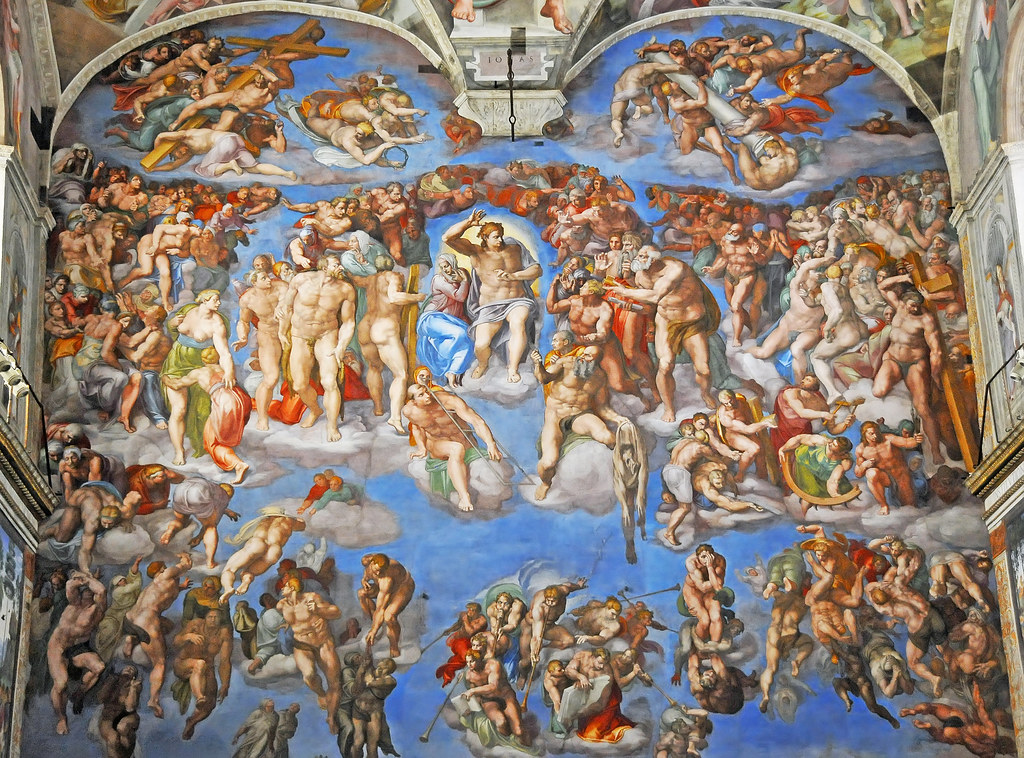 |
| 2 Corinthians 5:10 For we must all appear before the judgment seat of Christ; that every one may receive the things done in his body, according to that he hath done, whether it be good or bad. |
On the contrary, they are both faith based, as Scripture attests. Read Heb 11 and see annotated therein, the list of the Old Testament faithful, who obeyed and did the works of God, by their faith. They are put there as an example for us.
Hebrews 11:1 Now faith is the substance of things hoped for, the evidence of things not seen.
2 For by it the elders obtained a good report.
3 Through faith we understand that the worlds were framed by the word of God, so that things which are seen were not made of things which do appear.
4 By faith Abel offered unto God a more excellent sacrifice than Cain, ...
11 Through faith also Sara herself received strength to conceive seed, and was delivered of a child when she was past age, because she judged him faithful who had promised.
12 Therefore sprang there even of one, and him as good as dead, so many as the stars of the sky in multitude, and as the sand which is by the sea shore innumerable.
13 These all died in faith, not having received the promises, but having seen them afar off, and were persuaded of them, and embraced them, and confessed that they were strangers and pilgrims on the earth.
14 For they that say such things declare plainly that they seek a country.
15 And truly, if they had been mindful of that country from whence they came out, they might have had opportunity to have returned.
16 But now they desire a better country, that is, an heavenly: wherefore God is not ashamed to be called their God: for he hath prepared for them a city.
Those who have enough faith, will do the works which God wills for them to do. Old Covenant or New.
James 2:18 Yea, a man may say, Thou hast faith, and I have works: shew me thy faith without thy works, and I will shew thee my faith by my works.
So, what is the difference between the Old and New Covenants? It's illustrated in this parable:
Matthew 20:1 For the kingdom of heaven is like unto a man that is an householder, which went out early in the morning to hire labourers into his vineyard.
2 And when he had agreed with the labourers for a penny a day, he sent them into his vineyard.
3 And he went out about the third hour, and saw others standing idle in the marketplace,
4 And said unto them; Go ye also into the vineyard, and whatsoever is right I will give you. And they went their way.
5 Again he went out about the sixth and ninth hour, and did likewise.
6 And about the eleventh hour he went out, and found others standing idle, and saith unto them, Why stand ye here all the day idle?
7 They say unto him, Because no man hath hired us. He saith unto them, Go ye also into the vineyard; and whatsoever is right, that shall ye receive.
8 So when even was come, the lord of the vineyard saith unto his steward, Call the labourers, and give them their hire, beginning from the last unto the first.
9 And when they came that were hired about the eleventh hour, they received every man a penny.
10 But when the first came, they supposed that they should have received more; and they likewise received every man a penny.
11 And when they had received it, they murmured against the goodman of the house,
12 Saying, These last have wrought but one hour, and thou hast made them equal unto us, which have borne the burden and heat of the day.
13 But he answered one of them, and said, Friend, I do thee no wrong: didst not thou agree with me for a penny?
14 Take that thine is, and go thy way: I will give unto this last, even as unto thee.
15 Is it not lawful for me to do what I will with mine own? Is thine eye evil, because I am good?
16 So the last shall be first, and the first last: for many be called, but few chosen.
The first set of laborers, are those who do not accept the Sacraments. They will work their entire life, but will not be judged until they come to the Judgment Seat of Christ. At that time, those who claim salvation by faith alone, will be Judged by Christ. Whether they are truly saved, they will learn at that time.
The second set of laborers, are those who accept the Sacraments. Those who take them seriously, repent of their sins and do their best to obey God before and after receiving the Sacraments. They receive the Sacraments and are credited with righteousness for believing that God will keep His promises and for hoping in God for their salvation. Judgment comes to them in this life, everytime they approach the Altar:
1 Peter 4:17 For the time is come that judgment must begin at the house of God: and if it first begin at us, what shall the end be of them that obey not the gospel of God?
God only saves those who do His righteous works, whether it be through the Sacraments or at the Judgment Seat. Both Covenants are based on faith. And in both Covenants, faith without works, is dead.
Thursday, December 8, 2016
Subscribe to:
Posts (Atom)
Anon says:
1 John 3:4 Whosoever committeth sin transgresseth also the law: for sin is the transgression of the law..
Neither circumcision (Jews) nor uncircumcision (Gentiles) avail anything. Final justification is by faith working through love.
But for those who do not receive the Sacraments, Jews, Protestants, pagans and the like, it is accomplished with respect to God’s Judgment, on the Last Day:
Revelation 22:12-15
King James Version (KJV)
12 And, behold, I come quickly; and my reward is with me, to give every man according as his work shall be.
13 I am Alpha and Omega, the beginning and the end, the first and the last.
14 Blessed are they that do his commandments, that they may have right to the tree of life, and may enter in through the gates into the city.
15 For without are dogs, and sorcerers, and whoremongers, and murderers, and idolaters, and whosoever loveth and maketh a lie.
King James Version (KJV)
17 For ye know how that afterward, when he would have inherited the blessing, he was rejected: for he found no place of repentance, though he sought it carefully with tears.
18 For ye are not come unto the mount that might be touched, and that burned with fire, nor unto blackness, and darkness, and tempest,
19 And the sound of a trumpet, and the voice of words; which voice they that heard intreated that the word should not be spoken to them any more:
20 (For they could not endure that which was commanded, And if so much as a beast touch the mountain, it shall be stoned, or thrust through with a dart:
21 And so terrible was the sight, that Moses said, I exceedingly fear and quake:)
22 But ye are come unto mount Sion, and unto the city of the living God, the heavenly Jerusalem, and to an innumerable company of angels,
23 To the general assembly and church of the firstborn, which are written in heaven, and to God the Judge of all, and to the spirits of just men made perfect,
24 And to Jesus the mediator of the new covenant, and to the blood of sprinkling, that speaketh better things than that of Abel.